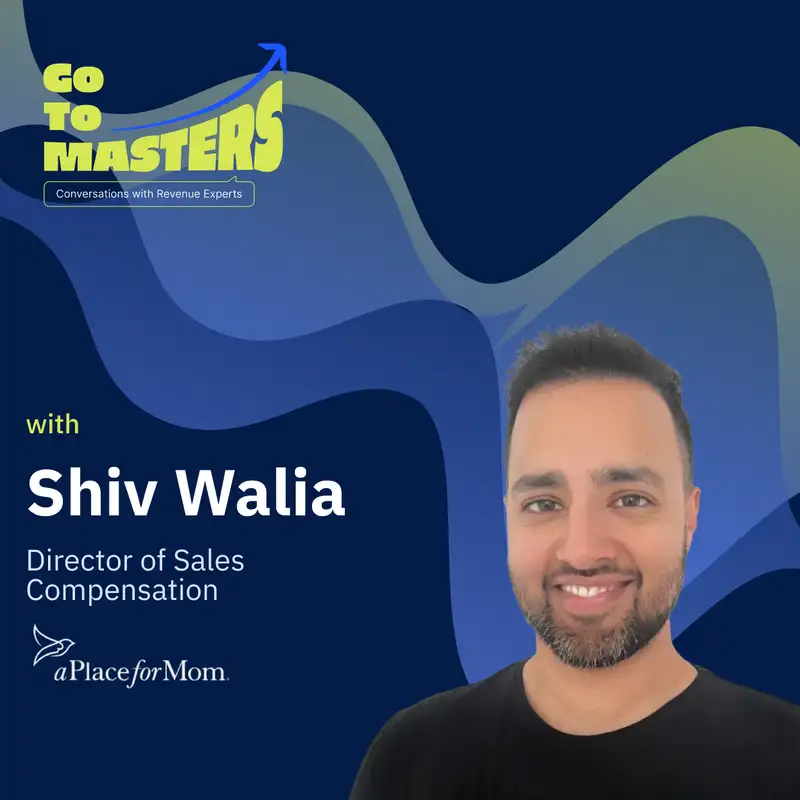
Shiv Walia on Why Bad Comp Plans Drive Attrition Faster Than Anything
Download MP3Hello, and welcome to a new episode of Everstate's Go To Masters. We converse with sales comp and g team leaders from some of the most successful companies today and learn from their unique stories. Joining us today is Shiv Walia, director of sales compensation from A Place For More. Shiv, thanks for joining us. Could you start by telling listeners a bit about yourself?
Shiv:Yeah. Of course. And a big hello to everyone who's joining in. My name is Shiv Walia. I lead sales compensation at A Place for Mom.
Shiv:I have been in the world of sales compensation for around five years now, but I've been in the GTS space for twelve years as I started out in sales operations. I did my background is in computer is in engineering. I started I got my undergrad in computer engineering, and I worked at Accenture as as a programmer for a couple of years. Then I got my MBA from Michigan State. And after that, I joined I joined Dell computers, and and that's where I I started my journey in the world of GTM and sales ops.
Shiv:I was at Dell for five years, and I did various roles in sales operations. And after that, I moved to Mindbody, and that is it's a SaaS company in the wellness space. And at some point, Mindbody acquired ClassPass, which is in the same space, but that's b to b. That's actually b to c. So there's a good experience of doing both b to b and b to c in sales ops and sales comp.
Shiv:And that's actually the company where I transitioned from my sales ops job to being in sales compensation. And now I'm at A Place for Mom. I lead the sales compensation team here. And NAPFM is it it's a US based company. It's it's in the senior living industry space, which is closely related to health care, and the company helps well, the company does is that we help people who are looking for senior living facilities for their parents and their loved ones, and we help them in finding these communities.
Shafeeque:Gotcha. And even it's very diverse in you know, over the years. So which early experiences most shape how we think about sales compensation as a strategic lever and not just a payout mechanism, Shiv Walia?
Shiv:Yeah. I think very early on I realized how a bad sales comp plan can actually lead to attrition and impact rep morale. And that actually even when I was at Dell in a sales ops role, I could see how having a comp plan, which is not motivating people enough, it needs it leads to attrition. And that was a company where there were thousands of sellers. And if you don't ensure that it's it's driving people the right way, a lot of attrition could happen.
Shiv:So just seeing how how much of a role it plays in keeping reps and ensuring that they're motivated, you know, it goes a long way by doing that right. And I was saying the thing is a little like, you know, it just it it shows you what I learned early on is that is that what people will focus on the most is what they're paid on. If you're paying a person for product a, but do you expect them to do something else? They're not gonna do that. You know?
Shiv:They'll they'll do mostly what they get paid on, and knowing that helps you as a company to set the right strategy.
Shafeeque:Got it, got it. And you've actually owned end to end comp cycles across multiple businesses, verticals and regions. So when you design a compensation plan today, what according to you are the non negotiable principles that you'd ensure drives the right behavior while it's still staying simple and scalable?
Shiv:I would say the biggest thing is ensuring that you have end to end clarity across all the stakeholders, including HR and finance, especially the sales team. As as what I've seen is that if you if everyone's not fully bought in into how you do things, how the picture is made, it could, you know, it it could cause problems. So all the sellers need to know what is the reporting you're using, who are the main report being used. It should be a a shared repo a shared report across teams, and it needs to be a sales compliant document that everyone you know, ideally, everyone has a copy and and assigned it and knows all the rules, and you have a structure in place of what you do with exception cases and stuff like that. So that end to end clarity, I feel like, is the most important thing.
Shiv:And apart from that, I would say ensuring that it aligns with the company goals or your sales team goals. Because what you don't wanna happen is that the company is hitting its goals and the sales team is not or vice versa. And that just you know, it creates a problem that you don't wanna have. And lastly, I would add, and this is a thing I see happen quite a, you know, like, quite a bit is is is you don't is make sure you don't confuse sales compensation and sales and sales performance management. Because as part of SPM, you can track a lot of things like dials and outreach and all the things that a sales rep is required to do.
Shiv:But from a sales comp perspective, I think it should be simple and scalable. I know we try to make sure that it's not it's not more than three or four main KPIs that they go after because otherwise, it really dilutes, like, what they need to do, and just keeping your focus on the main things and measuring those.
Shafeeque:Got it. Got it. And how do you think about aligning quotas and payments with real world capacity, especially given with leadership pressure, growth targets, and market realities always don't line up? So how do you think about it? Yeah.
Shiv:I feel like over there, what I do is I put my focus on data and strategy. One is ensure you have the data. If the finance team is is doing it top down of of what the goal needs to be, the sales op or rev ops or my team in sales comp is doing a bottoms up and kinda matching those two and ensuring that if we have a vision, we we can see how it plays out. And I have I myself in the past ensure that every time we are going into a new year or we're adding a new product or something and we have this big and audacious goals, I I kinda map it out and show the analytics. And it may show just like, you know, having a graph that shows here is where the rep productivity is now, and that's where we are planning to be.
Shiv:And does that make sense? As I remember, there was one time in the past where we had you know, it was a new year, and we had acquired a couple of new companies, and the and the productivity was expected to go up. But as I as I showed it visually that one person is doing, let's say, 20 sales in December, I'm expecting it to be 40 sales in January. You know? It it it seems plausible in theory, but when you see it in a graph, then you realize that, yep, you know, we actually can't just, like, do x overnight.
Shiv:It's gonna take some ramp time and all those things. So being able to show that, I think, it kinda goes a long way. And and yeah. But I've seen the past where, like, leadership perf is a lot. And, basically, what I do there is just, you know, I I try to create the right picture of of where do we stand right now and and and what's plausible.
Shiv:And if we do x y z, what kind of outcome it could lead to so that whoever is the decision maker has all the things that they need to make the final decision.
Shafeeque:Got it, got it. And sitting right at the intersection of sales, finance, HR, medium leadership, what have you found most effective in building alignment and trust across the different stakeholders? Especially given compensation decisions like you mentioned earlier, it directly, know, impacts the rep morale, impacts the attrition, and direct impact on revenue and cost of sales as well.
Shiv:Yeah. Yes. Building trust is a key thing, and I feel like in in my world, it's it's asking you to speak a lot of different languages fluently. You know? Finance case about cost, and HR case about equity and rep morale and attrition.
Shiv:Sales team obviously cares about, like, selling, and and our company has its its own goals. So they just you know, with all these things, I think my main thing is that one, I try to create a shared framework is that everybody needs to know what piece of the puzzle they're solving, how everything comes together, you know, in case you're doing benchmarking, that that comes from HR. If the sales team is is doing their goals and and is figuring out, like, what's a good sales goals, is providing that that picture of, you know, that if you want to achieve this goal, this is how the quotas are gonna look like and how that compares how that compares to the past, how is the team going to take it, and stuff like that. And also working with the finance team, ensuring that they can understand that that, you know, as they're doing a top down modeling or forecasting, keep in mind how we expect our hiring and attrition. Are we adding new teams?
Shiv:Are we expanding to new regions? How are going to scale? So, yeah, just, you know, having a framework where everything is being defined and being followed. Another thing I do is just, you know, I think with stakeholders and the sales team is ensure that there is through and through transparency. Especially with the sellers, I don't want to surprise them with, like, something new that that's not expected.
Shiv:You know? And if you if you are regularly having conversation with the sales team and you're sharing what you're doing and sharing with leaders, so, you know, a lot of times, targets are going up and leaders question that. I'll just make sure that I have all the data, all the strategy notes of of the what and why. And that way, someone asks, like, you know, that's that's a crazy goal or it's too much. I can actually explain how we're thinking about it and also question those those who are making the decisions that, you know, that we can't just improve things overnight.
Shiv:If we are having bigger goals, we need to be able to explain if it's because of a new m and a having having better features, like, how it's it's all coming together. And I have seen that as especially with especially with sales reps and managers. The more transparent you are, the better it is for you in terms of in terms of selling a comp plan and ensuring that everyone's, like, bought in and and is excited about what expected to do.
Shafeeque:Absolutely. And what are the common mistakes that companies usually make when scaling or changing compensation models? And how do you think leaders can avoid breaking the motivation during these transitions?
Shiv:Yeah. I think I think one big mistake is just is is is looking at sales comp in a silo. You know, if you just care about the comp curve and stuff like that, and you don't think about the targets and the territories and and how you have, like, different rules, then you you might get into a situation where you have a really good pay curve, but no one's really hitting the gate. And that's that's because the quotas were really high. Or or if it's vice if it's the opposite, it's it's even worse.
Shiv:Right? That it could be just some it could be very easy goals, and everyone's hitting their accelerators. And you are achieving your goal, but your profit margin is being impacted as everyone's earning, like, very high accelerators. So all these things, I think, your targets and territories and quota and and your comp plan, those need to be, like, thought of as one system. And if you're changing one thing, you kinda need to see how is this going to impact the rest of it.
Shiv:Another big thing is that, you know, in sales comp, I always tell my team, this is a very emotional topic. So, you know, those who just think that, of course, sales comp is a lot of data and a lot of strategy, but you are telling someone how they're going to earn their paycheck at the end of the day. And that can be very you know, it it's an emotional and psychological topic. And if you just if you just look at the data part and you forget this, one, it'll be very hard to get buy in. And, you know, that might create an environment where your sellers are not really motivated.
Shiv:So ensuring that you also keep in mind that you're dealing with a person's livelihood and how they make money and ensure you are focusing on that and and even tweaking your message in case you're doing something which is completely different in terms of change management or adding something new, ensuring that it will be taken well. And I would say lastly is, you know, one mistake I've made myself in the past is when doing something new especially is not thinking about the edge cases. Is that you know what happened 90% of the time, and you make very, like, you know, rigorous rules around that. But the 10%, they don't think about, and then it happens in real time. And then and then you don't know what to do about that, and you need to reach out to a lot of other people and figure out what the rule needs to be, if that's an exception or it's it's a go forward rule.
Shiv:So ensuring that if you're changing something or you're doing something new, you are you know, the you've gone through all the edge cases and seeing what it could be and and and ensuring that all your rules are covering, I would say, 99% of the things that could happen.
Shafeeque:I'd really loved your perspective on the compensation front and how the human touch that you gave it to it. Looking ahead, where do you see AI having the most practical impact on sales compensation and sales operations, and whether the quota modeling, plan simulation, dispute resolution, or even productivity insights for that matter? Where do you see human judgment must still remain front and center, and AI should step
Shiv:I mean, I think one big thing is is definitely planning simulations. You know, when you're doing quotas or territories, there are so many different ways that that you can slice things and just you know? And and maybe there is a way I can help in in looking at so many different things and seeing, like, you know, what are the different options you have. And in each of those, if anything happens, how can you change things and and kinda react just real time in case you have unexpected attrition or an unexpected addition of new products? It's like, how do you very quickly change things?
Shiv:Because it is a very touchy topic. I know in the past when I was in sales ops doing territories and planning, that would take a lot of time. Maybe, you know, be if you're doing that for 2026, you start at at the mid of 2025 is when you start to create those territories. And then at times, out of nowhere, this change of leadership where you buy a new company, and then everything is gone. It's like, know, you have to start from scratch.
Shiv:So I feel like that's where AI can help. I do feel in terms of, you know, all the all the manual things and all the questions we get in our mailbox and, you know, like, quizzes from sales teams, that I would say, for my team, it takes around 10 to it takes, like, 10 to 15% of their time is answering why my payout is like this or, like, what you're looking at. And all those things are basically based on rules. Rules which are part of the comp plan is just that not everyone has gone through it and and thoroughly looked at it and is is trying to figure out how their paycheck is coming about. I feel like since the rules are are clear cut in in a in a complaint document, AI can help to really answer those questions that here, you know, like, we as an example, you just came back from LOA, and because of that, you have no gate.
Shiv:And that's why you're earning like that. Because I've seen I've seen in my own experience, reps just want their payout to be correct. At times, even when you even when you overpay them, they reach out and ask that, I was not expecting this much. How come I'm I'm earning this? Because, you know, they they actually do care about ensuring that they know exactly how the comp plan works and ensuring that they are tracking the same number.
Shiv:So helping with such things and explaining the rules, I feel like, you know, it could be a big thing. And lastly, one thing which I'm excited about, I don't know if we really get there. I feel like the it's I feel like it could be a really cool thing is to help with real time conversations. You know? And that's just you know?
Shiv:And it's I feel like this is more this is not on the sales comp team, but it's more it's more for the sales team. You know? Because at the end of the day, sales are my customers. I I, you know, I think about all the different things that I can do and my team can do to help sales teams. I feel like if AI can help sales reps who are talking to customers to, you know, to guide them what to say and what is going to help them to sell better, that's actually going to increase their sales and increase productivity and just create more efficiencies.
Shiv:So I know I feel like we there are some ways to go there, but it's one of the exciting opportunities of how AI can help you in real time.
Shafeeque:And where do you think humans, gentlemen should still remain, at core,
Shiv:Oh, that I mean, yes. One, I feel like humans, especially in a topic like sales comp, it's you know, they have to remain. One, I would say is is just because, you know, sales comp is is a topic where you expect pinpoint accuracy. You know, I can't in finance, you're gonna be off by some units or some dollars, and there's a bit of a approximation that that flies. In sales comp, everything's gotta be correct to the dollar.
Shiv:So ensuring that you are kind of, like, you know, doing the double checks and everything is correct just before everything is stamped, I feel like that aspect is going to be there. And other small things, like, you know, dealing with exceptions and trade offs. Of course, at times, there's a a case where a person went out on leave, got on PTO, and another person helped out, and you're trying to figure out who gets credit. If you go by the rule, it's the person who closed the deal that, you know, AI can do that. But at times, there's this case where it is okay to double and triple pay because, you know, everyone put in the effort, and only a human can make that judgment call is that did the person who closed it do more or the other person did, and they should get, like, an equal an equal share, or it's it's more one the other.
Shiv:So, like, I I feel like some decisions are based on your gut and and are going to impact rep morale, and those can it can't and even should not be taken by AI. It's the the person who is responsible should make that call and and ensure that it's it does the right thing.
Shafeeque:You know, as we see everything shifting more complex and data driven and also AI shaping up, what's in sales comp and or, you know, rev ops need to start preparing from now to stay ahead of the curve for the next few years?
Shiv:One, I mean, know, like, talking about territories, I feel like, helping I remember I used to spend a lot of time on this. I feel like in the future, AI can help with doing things like territories dynamically. Because, like, you know, that's it's always a big lift. And if you're able to tell what makes more sense at one point, that can actually increase efficiency even as a seller. Because because you're not just bound by a static piece of the pie, and that's your focus.
Shiv:If there is an opportunity to do more and we can and we can easily see where that is, I feel like, you know, that's that's going to really increase their productivity. And another thing I would say, which I know is is kind of a big thing being talked about today, is predictive lead scoring. Is that, you know of course, right now, we pay the same for any two deals that you close. As long as that's the territory, any two deals are giving you the same quota attainment. But in reality, there is one deal where, you know, it was an inbound, and we know the customer really wants this.
Shiv:And maybe even it's part of a chain that had, like, 10 locations, and you're selling it to the you're trying to sell to the tenth one, that's that's going to be a very easy sell. Right? It's it's always like it's a done deal because it's your own own customer, and they're just adding a new location. Or it could be like you're trying to sell to a mom and pop where it's a person who is just, like, testing the waters and try to buy something. That is a much more difficult selling thing.
Shiv:So right now, they're both paid the same. If we could have this predictive scoring of what's easy, and that's going to take you less time and and you're going to close that fast. While this other thing, one, if it's harder, we can maybe pay you more on it. It's like it's like a 1.5 x based on this because it's a small moment pop. It seems like it's gonna be very hard to close this.
Shiv:And if you close this, you gotta deserve more. Like, it helps us on the comp side to motivate them the right way, and it helps them to know that, okay. This is gonna be much harder. I need to have a plan. I need to know what to say at one point and and how to you know, if they have any things that they are not sure about or or are con are confused about, how can I help them make a decision?
Shiv:So just that kind of predictive scoring of what's easy and what's not, I feel like that's gonna go a long way. And I guess in in the long run, AI could also help with having lesser sellers. You know, if you just help with decision making, like, if I'm trying to buy something for my company, I can use AI to really figure out what are are the best options out there and really just, like, focus on a couple of things on a couple of companies I need to go for. That way, I think it creates efficiencies everywhere. You know?
Shiv:The number of companies I'm looking at is less. I completely know who is going to serve my needs, and that we just need, like, lesser sellers. So I feel like that that could be the future of AI in sales and sales comp, but, yeah, I don't know when and where, you know, at one point that could be.
Shafeeque:Fair enough. And are there any books, resources, or communities that you'd recommend for someone who's looking to grow a career in the spaceship?
Shiv:Books? Well, I don't think I've actually read any books which are in sales comp, but Mhmm. One yeah. You know? Because that is just I mean, it's very analytical and it it's data.
Shiv:Right? I'd be very bored if I had a book which is about about sales comp. I would recommend a book called that's called Drive. You know, it's it's about it's about what motivates us as human beings, and I feel like that really kind of helped me understand how we think and how any any seller would think about what motivates them and drives them. I feel like that was a very interesting read and is applicable to our work.
Shiv:In terms of communities, I would say, you know, there are, first of podcasts are a really good way of just learning. Each each podcast has its own, like, own topic. And based on what they're doing, you can try to figure out what can I learn from this? I was part of this a community of this community called RevOps Co op. I it was free.
Shiv:It's paid now, but I feel like I made some friends there. I learned a lot as getting into sales ops and sales comp, and and people were both, like, really sharing ideas, and that was cool. And I also look at LinkedIn, and I connect with other leaders, other people who are in the GTM space. I feel like, you know, people are are always welcome to to answer any questions or provide their input if they're trying to solve some things. I feel like, you know, just yeah.
Shiv:You know, I would really say trying to reach out to a community is really helpful if you're trying to grow more or you're trying to solve something.
Shafeeque:Fair enough. And, you know, if you were to give three pieces of advice to someone who wants to build long term and thought in sales comp and DevOps space, you know, what would that be?
Shiv:I would say number one, if you need to buy it, and I've said it before, I feel like this is a very emotional topic. And it you know? So, like, always keeping in mind that there there is a human at the other end of this and ensuring that anything you do is impacting someone and keeping that in mind. I feel like, you know, that is kinda important. And then and and something to go along with that is that do invest in relationships.
Shiv:You know? Obviously, it's a lot of data and strategy, but but if you have the right relationships, it's going to it's going to help you to make it work easier. One thing I learned early on is that if you're in the world of GTM, it's good to get comfortable with ambiguity. Because there is you know, especially if you're in the startup world, which I was at some point, there is just a lot of different things you need to handle. Anyone have the answers.
Shiv:So, you know, just being good with ambiguity and working through it is really gonna help you. And something similar to that, then the last thing I would say is is you need to trust your gut and make a decision. And I felt like I learned that the hard way because sometimes I would just take so much time kinda trying to make something perfect and have the perfect execution. And by the time I get to it, it's kinda too late. You know?
Shiv:Because it's just keeping in mind that that failure is okay. Everybody makes mistakes as long as you're learning from it. I've I've basically I've learned a lot from my mistakes. So so it's a it's only I've tried myself. Yeah.
Shiv:You know? So just make a decision that is have some logic to it, entrust your gut and make it, and see where that takes you.
Shafeeque:Sounds beautiful. And, well, that brings us to the end of this insightful episode of Roadmasters. A big thank you to Shiv for sharing his experiences and perspective on sales commission strategy and the future of GTM. Remember, you can tune in every week to learn from leaders driving hyper growth companies across the globe. Go To Masters is brought to you by Everstage, your trusted partner for transforming the way businesses handle sales compensation.
Shafeeque:I'm your host, signing off.
Creators and Guests